Frankliniella musaeperda Hood, 1952: 137.
Original reference: Hood JD (1952) A new Frankliniella injurious to banana (Thysanoptera, Thripidae). Proceedings of the Biological Society of Washington 65: 137–139.
Family
Thripidae, Thripinae
Nomenclatural information
http://thrips.info/wiki/Frankliniella_musaeperda
Diagnosis
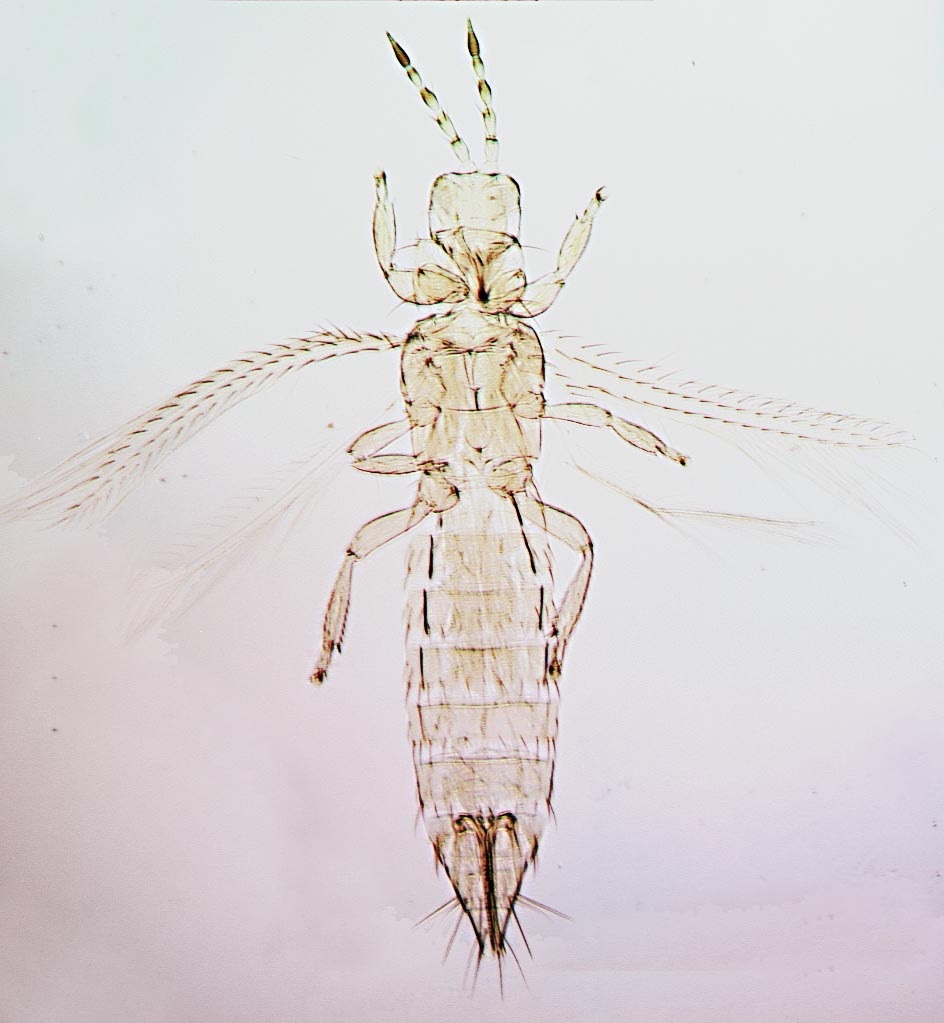
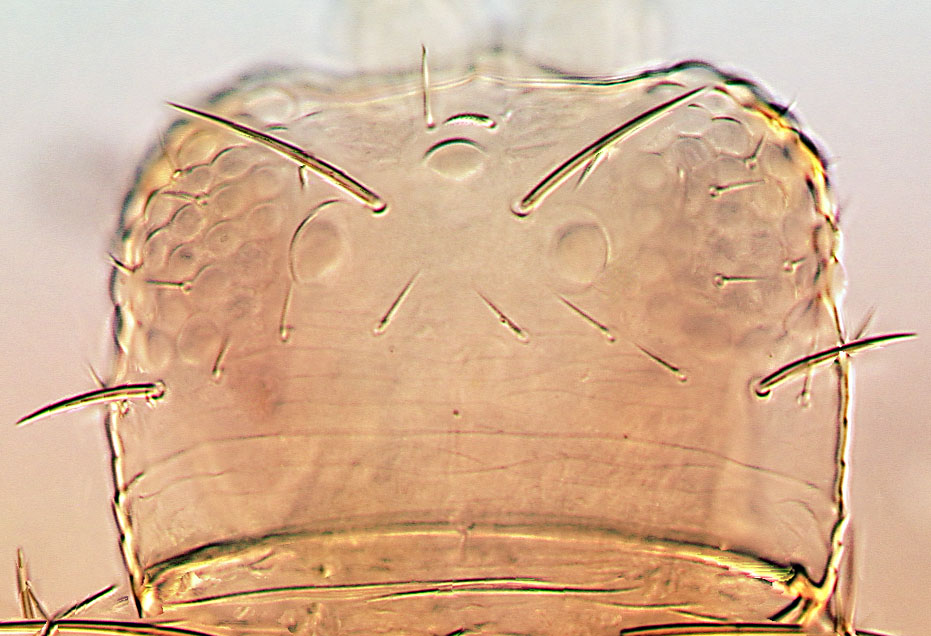
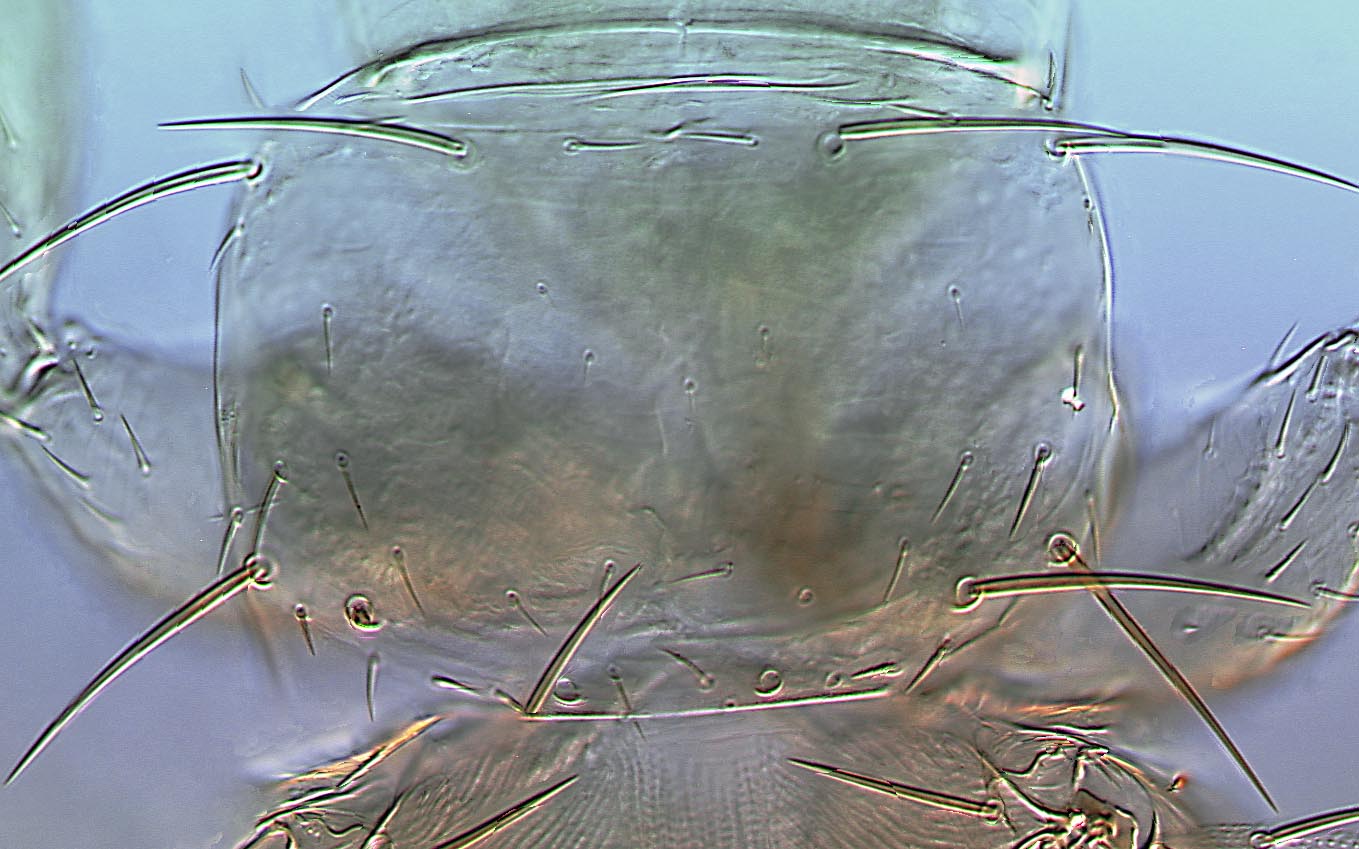
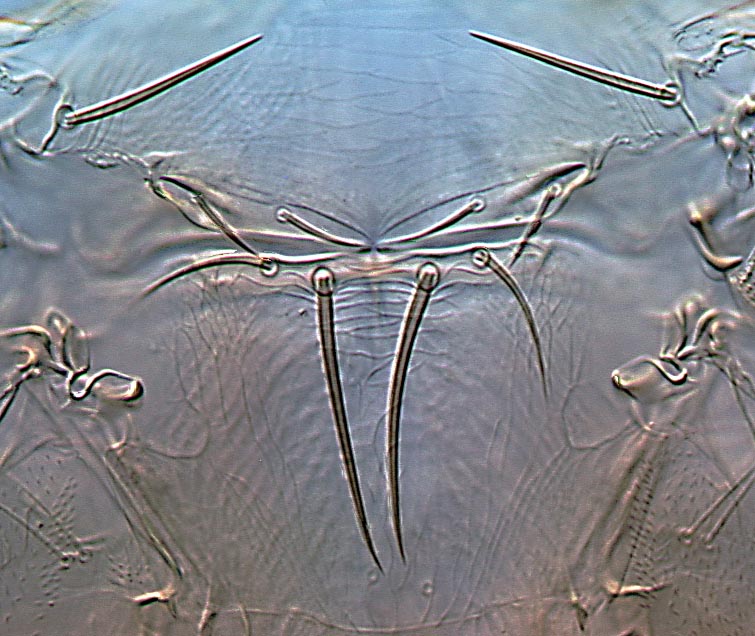
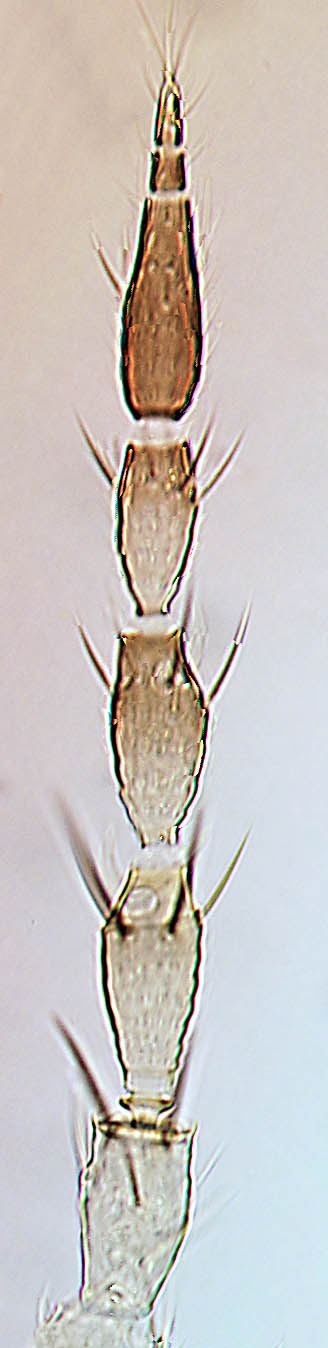
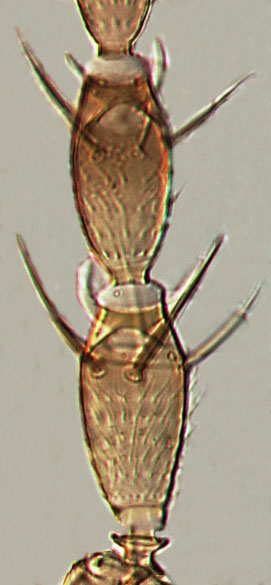
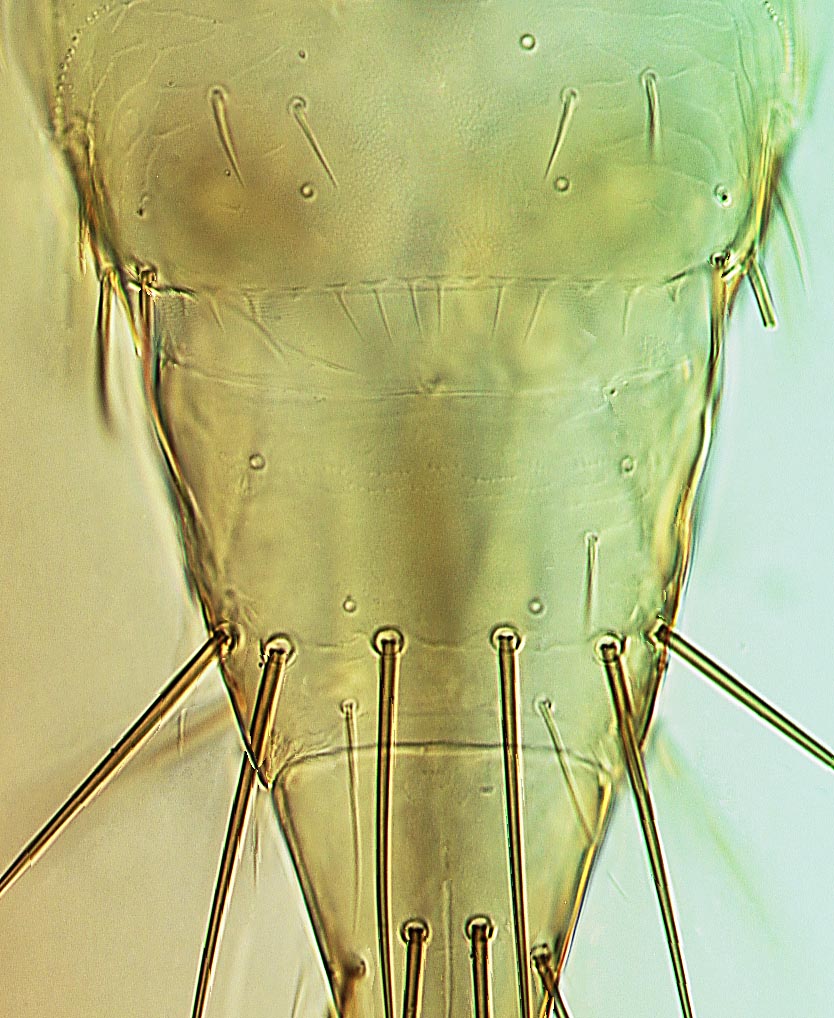
Body yellow, including legs; antennal segments I–II yellow, III–V brown in apical half, VI–VIII brown; fore wings pale. Head with three pairs of ocellar setae, pair III long and arising within ocellar triangle. Antennae 8-segmented, III & IV with forked sense cones; III with a well-developed disc on pedicel, usually slightly longer than base of antennal segment II. Pronotum not sculptured, with two pairs of long posteroangular setae; anteroangular and anteromarginal setae long, but less than 0.5 pronotum length. Mesothoracic spinula long, metathoracic spinula absent. Metanotum with transverse lines of reticulation anteriorly, reticulate posteromedially; campaniform sensilla present; two pairs of setae arising at anterior margin. Tarsi 2-segmented. Fore wing with first and second rows of setae complete and closely spaced. Abdominal tergites V–VIII with ctenidia laterally, ctenidia on VIII anterolateral to spiracle; VIII with complete posteromarginal comb of microtrichia. Sternites without discal setae, with three pairs of long posteromarginal setae. Both sexes fully winged.
Male with transverse pore plate on abdominal sternites III–VII.
Intraspecific variation
Not recorded.
Genus and similar species information
Frankliniella is one of the largest genera amongst Thysanoptera, comprising more than 160 described species. About 90% of the species are from the Neotropics and their taxonomy is usually complex. Almost all members have 8-segmented antennae, three pairs of ocellar setae and fore wing with both rows of setae complete. About 40 species are referred to Brazil, almost half described from this country. Frankliniella musaeperda resembles F. gardeniae but can be distinguished by the well-developed disc on antennal segment III. A key to Frankliniella species recorded from Brazil is provided by Cavalleri & Mound (2012).
World distribution
Described from Dominican Republic; it is also known from Brazil and Haiti.
Distribution in Brazil
http://fauna.jbrj.gov.br/fauna/faunadobrasil/52515
Life history
Breeding on flowers of several unrelated plants. It is frequently found on flowers of Palicourea rigida (Rubiaceae) (Cardoso et al. 2016), Hancornia speciosa (Apocynaceae) and Byrsonima (Malpighiaceae) in Southeastern Brazil (Alves-Silva et al. 2013).
Economic importance
Described from Dominican Republic causing damage to banana plants.
References suggested
Alves-Silva E, Maruyama PKM, Cavalleri A & Del-Claro K (2012) Flower stage and host plant preference by floral herbivore thrips (Insecta: Thysanoptera) in a Brazilian savanna. Studies on Neotropical Fauna and Environment 48: 25–31.
Cardoso JCF, Gonzaga MO, Cavalleri A, Maruyama PK, Alves-Silva E (2016) The role of floral structure and biotic factors in determining the occurrence of florivorous thrips in a dystilous shrub. Arthropod-Plant Interactions 10: 477–484.
Cavalleri A & Mound LA (2012) Toward the identification of Frankliniella species in Brazil (Thysanoptera, Thripidae). Zootaxa 3270: 1–30.
Mound LA & Marullo R (1996) The Thrips of Central and South America: An Introduction. Memoirs on Entomology, International 6: 1–488.
Attendance
Brasil, Rio Grande do Sul, Rio Grande
Campus Carreiros: Av. Itália km 8
Bairro Carreiros
Thysanoptera © Todos Direitos Reservados 2026